

 Google Reviews
Content professionally reviewed by Dr. Nguyen Ngoc Tan
DDS, Dental Implants Specialist Trained in Brazil
Screwless Dental Implants cost is often higher than traditional screw-retained implants, which is why many patients begin to question whether the additional investment is truly worthwhile. By the time most people start researching screwless implants, they are no longer interested in basic explanations of how the system works. What they really want to know is whether the benefits they receive justify the extra cost.
In reality, the difference between screwless and traditional implants goes beyond the initial treatment fee. Factors such as prosthetic design, long-term aesthetics, future maintenance requirements, and overall patient experience can all play an important role in the value of treatment over time. In this article, we’ll explore screwless dental implant costs in different countries, examine the key factors that influence pricing, and help you determine whether this approach is the right fit for your needs and expectations.
How Much Do Screwless Dental Implants Cost? Global Price Comparison for 2026
For many patients, cost becomes the deciding factor when comparing different implant options.
After all, when you discover that a screwless dental implant may cost more than a traditional screw in teeth, it’s natural to wonder whether the additional investment is actually justified.
At our implant center, this is one of the most common questions we hear from international patients.
Interestingly, most people aren’t looking for a simple price range. They want to understand what they’re paying for, why prices vary so dramatically between clinics, and whether a premium implant system will genuinely improve their long-term outcome.
The truth is that implant treatment is rarely as simple as comparing two numbers.
A patient replacing a single front tooth may prioritize aesthetics above everything else. Another patient restoring multiple missing teeth may be more concerned about durability and maintenance over time. Someone considering dental tourism in Vietnam may be focused on achieving the highest level of care while staying within a realistic budget.
For this reason, understanding the real cost of screwless dental implants requires looking beyond the implant itself.
The final treatment fee often reflects:
- Implant system and connection design
- Crown and prosthetic materials
- Laboratory customization
- Digital treatment planning
- Surgical complexity
- Bone quality and available bone volume
- Long-term maintenance considerations
- The experience of the implant team performing the treatment
When viewed from this perspective, the discussion becomes much more meaningful than simply asking whether one implant costs more than another.
What Is Included in the Cost of a Screwless Dental Implant?
One of the biggest reasons patients become confused when comparing treatment quotes is that not every clinic includes the same services.
A quote from one provider may only cover the implant fixture itself, while another clinic may include diagnostics, surgery, temporary teeth, follow-up care, and the final crown.
Before comparing prices, it’s important to understand what a complete implant restoration actually involves.
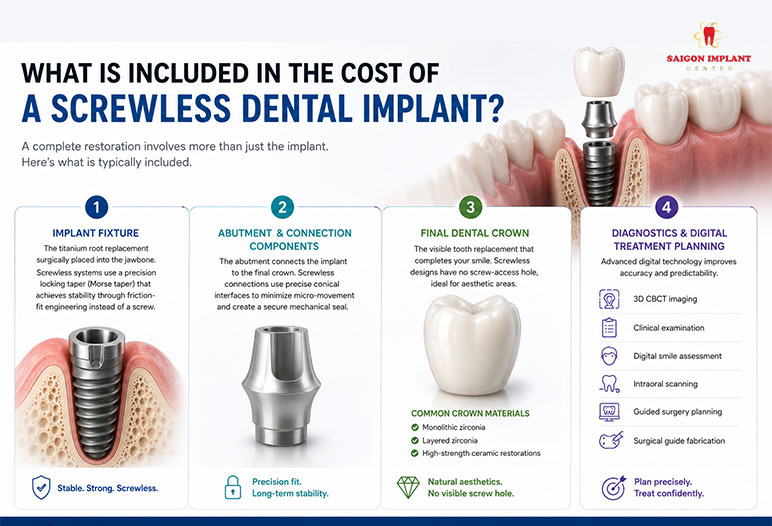
Implant Fixture
The implant fixture is the titanium root replacement that is surgically placed into the jawbone.
Many screwless systems use a precision-engineered locking taper or Morse taper connection that creates stability through friction-fit engineering rather than a traditional retaining screw.
This manufacturing precision is one reason why some screwless implant systems are positioned within the premium segment of implant dentistry.
Abutment and Connection Components
The abutment connects the implant fixture to the final crown.
In screwless systems, the connection often relies on highly accurate conical interfaces designed to minimize micro-movement and create a secure mechanical seal.
The quality of these components plays an important role in the long-term stability of the restoration.
Final Dental Crown
The crown is the visible tooth replacement that patients see when they smile.
Because screwless restorations do not require a screw-access hole through the crown, many clinicians prefer them in highly aesthetic areas, particularly the upper front teeth.
Common crown materials include:
- Monolithic zirconia
- Layered zirconia
- High-strength ceramic restorations
The choice of material can influence both aesthetics and cost.
Diagnostics and Digital Treatment Planning
Modern implant dentistry relies heavily on digital technology.
A comprehensive treatment plan may include:
- 3D CBCT imaging
- Clinical examination
- Digital smile assessment
- Intraoral scanning
- Guided surgery planning
- Surgical guide fabrication
While these technologies increase treatment costs, they often improve accuracy and predictability.
Follow-Up Care
Long-term implant success depends on ongoing monitoring and maintenance.
Follow-up appointments allow clinicians to evaluate healing, monitor bone stability, and address potential issues before they become larger problems.
When comparing treatment estimates, always ask whether these visits are included in the quoted fee.
A successful screwless implant restoration relies on more than just a premium fixture—it requires a precise digital treatment plan and highly customized laboratory craftsmanship. When comparing prices, look beyond the initial number and confirm that your quote is fully inclusive, covering everything from the 3D CBCT diagnostics and temporary restorations to the final custom crown.
Average Screwless Dental Implant Costs Around the World (2026)
The cost of screwless dental implants varies significantly from country to country. Differences in labor costs, laboratory fees, healthcare regulations, clinical overhead, and specialist training all contribute to treatment pricing. The following ranges represent typical market estimates for a single screwless implant restoration in 2026.
| Country | Average Cost Per Tooth |
| USA | $3,500 – $6,500 USD |
| Australia | $3,200 – $5,800 USD equivalent |
| Canada | $3,500 – $6,500 CAD |
| United Kingdom | £2,800 – £5,500 |
| Singapore | SGD4,000 – SGD 7,500 |
| Thailand | Lower than USA and Australia |
| Vietnam | Significantly lower than USA and Australia |
These figures should be viewed as general market ranges rather than fixed prices. Every patient presents unique anatomical conditions, treatment goals, and restorative requirements that influence the final cost.
Screwless Dental Implants Cost in Vietnam vs USA vs Australia
One of the reasons patients spend so much time researching screwless dental implant costs is the significant price difference between countries.
Over the past few years, we have seen a growing number of patients from Australia, the United States, Canada, and the United Kingdom explore treatment options abroad—not simply because they are looking for lower prices, but because they want better overall value.
The reality is that a dental implant placed in Vietnam may involve the same internationally recognized implant system, the same digital planning technology, and the same restorative materials used in Western countries. Yet the final treatment fee can be dramatically different.
Understanding why this happens helps patients make more informed decisions.
Screwless Dental Implants Cost USA
The screwless dental implants cost USA is among the highest in the world.
For a single tooth replacement, patients can typically expect to invest between $3,500 and $6,500 USD, with some complex aesthetic cases exceeding this range.
Several factors contribute to these costs:
- Higher clinical overhead
- Increased staffing expenses
- Laboratory fees
- Regulatory compliance requirements
- Specialist treatment fees
- Rising healthcare operating costs
For many American patients, implant treatment represents a significant financial commitment, especially when multiple implants or dental rehabilitation is required.
Screwless Dental Implants Cost Australia
The screwless dental implants cost Australia follows a similar trend.
Most patients can expect treatment fees ranging from approximately $3,200 to $5,800 USD equivalent per tooth, depending on complexity and location.
Australia maintains exceptionally high standards of dental care, but treatment costs are influenced by:
- High labor expenses
- Laboratory costs
- Professional insurance
- Specialist training and qualifications
- Advanced digital technology investments
As a result, many Australian patients begin exploring dental tourism options after receiving treatment estimates for multiple implants.
Screwless Dental Implants Cost in Vietnam
The screwless dental implants cost in Vietnam is often considerably lower than in the United States or Australia. For international patients, savings can range from 40% to 70%, depending on the treatment plan.
However, lower cost alone should never be the primary reason for choosing a clinic.
Patients should evaluate:
- The experience of the implant specialist
- Diagnostic technology
- Sterilization protocols
- Implant brands being used
- Laboratory quality
- Long-term follow-up support
The best dental tourism experience combines affordability with safety, expertise, and predictable long-term outcomes.
Many international patients discover that the real advantage is not simply spending less—it is receiving high-quality care while avoiding the financial pressure often associated with implant treatment in their home country.
For your reference, the table below outlines our standard screw-retained implant pricing. For specific details and pricing on screwless implant alternatives, please get in touch with us for a direct clinical consultation.
| TREATMENT | PRICE IN USD | NOTE |
| Premium Korea Implant (Dentium) | $720 | per implant |
| Superline Implant (America) | $880 | per implant |
| JD Dental Implant (Italy) | $1,000 | per implant |
| Kontact / Neodent Implant (France / Switzerland) | $1,000 | per implant |
| Nobel / Straumann SLA Active Implant (Switzerland) | $1,400 | per implant |
| Titanium-porcelain Restoration | $120 | per crown |
| Full Zirconia CAD/CAM Crown on Implant | $320 | per crown |
| TREATMENT | PRICE IN USD | NOTE |
| All-on-4 Dentium (Incl. Implants + Reinforced Provisional) | $3,800 | per arch |
| All-on-4 Straumann Neodent (Incl. Implants + Reinforced Provisional) | $5,000 | per arch |
| All-on-4 Nobel / Straumann SLA Active (Incl. Implants + Reinforced Provisional) | $6,600 | per arch |
| All-on-6 Dentium (Incl. Implants + Reinforced Provisional) | $5,400 | per arch |
| All-on-6 Straumann Neodent (Incl. Implants + Reinforced Provisional) | $7,000 | per arch |
| All-on-6 Nobel / Straumann SLA Active (Incl. Implants + Reinforced Provisional) | $9,400 | per arch |
| Titanium bar + Premium acrylic teeth + Abutment | $1,400 | per arch |
| Titanium bar + Full-Zirconia CAD/CAM teeth + Abutment | $4,000 | per arch |
| SAIGON IMPLANT CENTER offers a bonus combo valued up to 400 for clients who decide to proceed with full-arch implants |
|
|

Screwless Dental Implants vs Traditional Screw-Retained Implants: Cost and Value Comparison
After understanding how screwless implant costs are calculated, the next logical question is whether the additional investment actually provides meaningful advantages.
For many patients, the decision isn’t simply about choosing the less expensive option. It’s about finding the treatment approach that offers the right balance between aesthetics, durability, maintenance requirements, and long-term value.
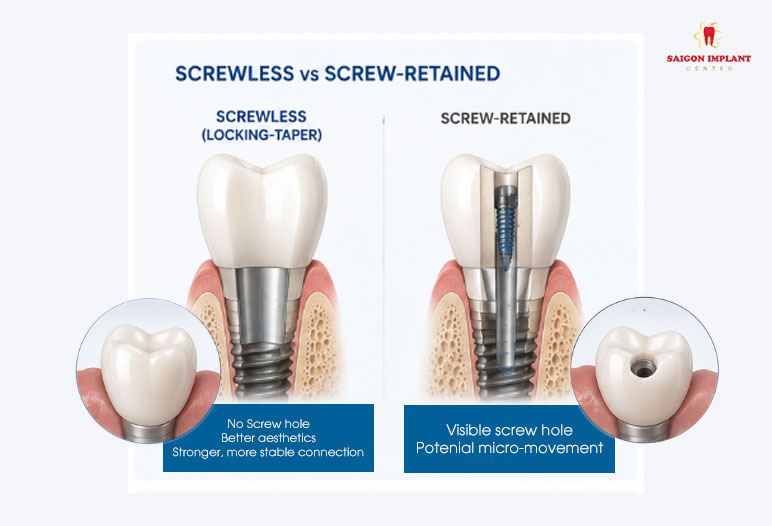
Both screwless and screw-retained implant systems have been used successfully for decades. However, there are several important differences that may influence which option is more appropriate for a particular patient.
Side-by-Side Cost Comparison
At first glance, screwless implant systems are often positioned within the premium segment of implant dentistry.
| Factor Screwless | Dental Implants Traditional | Screw-Retained Implants |
| Initial Treatment | Typically Higher | Typically Lower |
| Component Complexity | Higher | Higher Moderate |
| Laboratory Customization | Customization | Often Greater Variable |
| Aesthetic Restoration | Highly Customized | Highly Customized |
| Availability Worldwide | Worldwide More Limited | Widely Available |
| Long-Term Mechanical | Maintenance Potentially Reduced | May Require Periodic Maintenance |
For a single tooth replacement, the difference in upfront cost is often modest compared to the total treatment investment. However, the gap may become more noticeable when multiple implants or full-arch restorations are involved.
The more useful question is not which option costs less today, but which option provides better value over the lifespan of the restoration.
Aesthetic Differences
Aesthetics is one of the main reasons patients consider screwless dental implants.
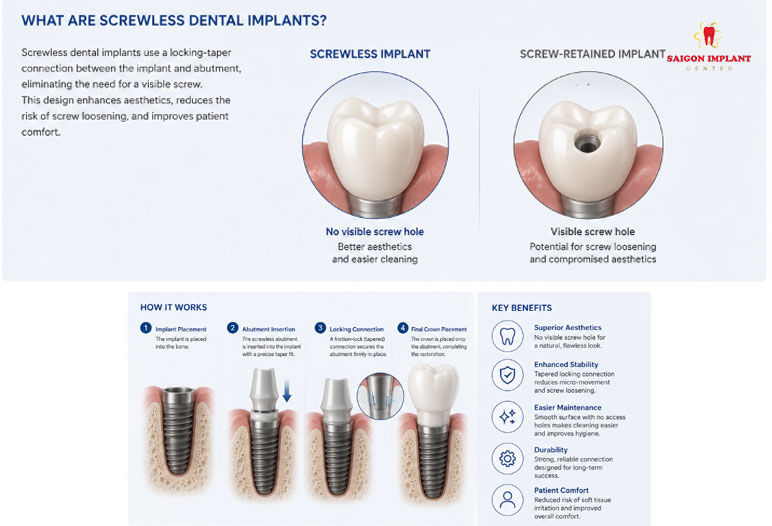
In a screw-retained restoration, access to the retaining screw requires a small channel through the crown. While modern restorative techniques can conceal this access hole effectively, it remains a design consideration.
Screwless restorations eliminate the need for a screw-access channel altogether.
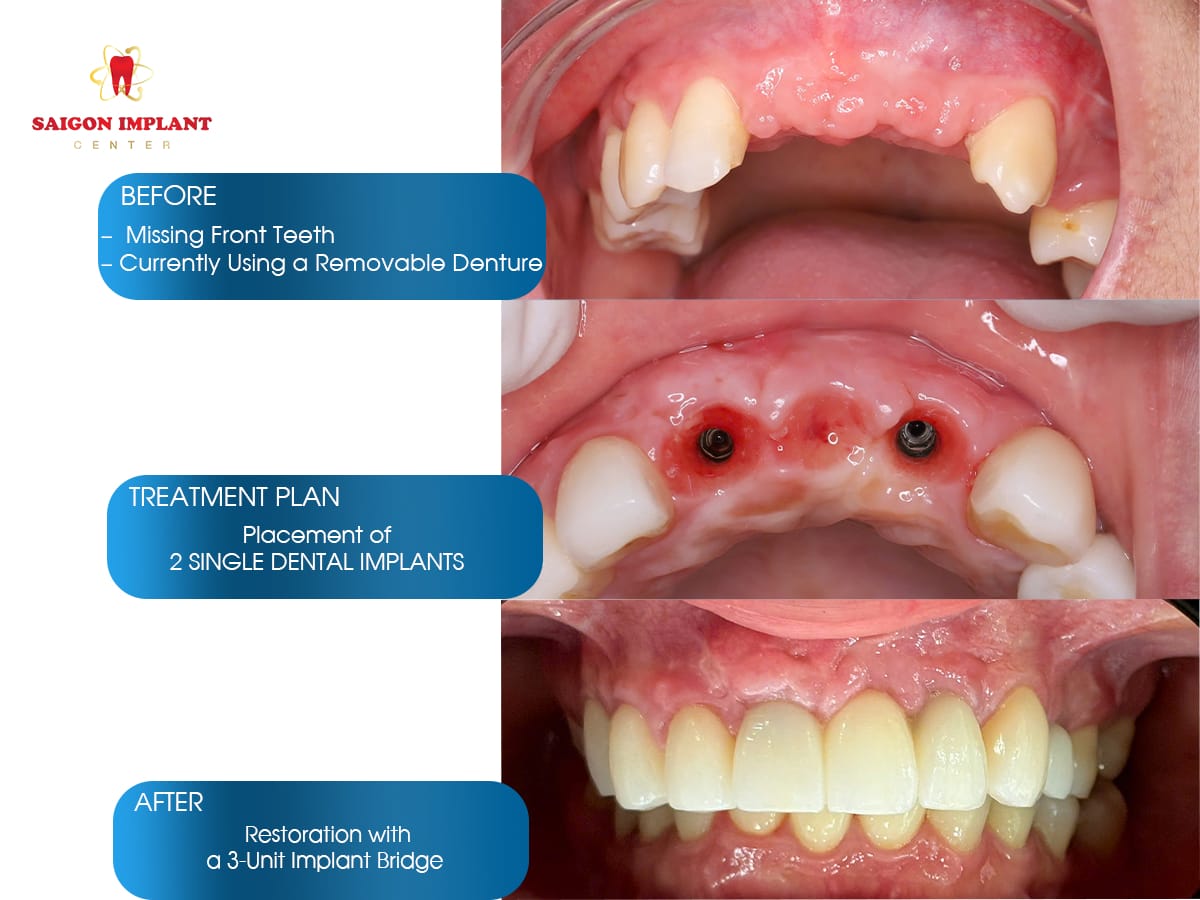
This allows laboratory technicians greater flexibility when designing:
- Crown contours
- Surface anatomy
- Light transmission characteristics
- Emergence profile at the gum line
For highly visible areas such as the upper front teeth, some clinicians prefer screwless restorations because they may support a more natural-looking final result.
That said, excellent aesthetics can be achieved with both systems when treatment planning and laboratory work are performed at a high level.
Mechanical Differences
The primary difference between these systems lies in how the restoration connects to the implant.
Traditional implant systems typically use a retaining screw to secure the restoration.
Screwless systems often rely on:
- Locking taper connections
- Morse taper connections
- Friction-fit engineering
Rather than depending on screw preload, stability is achieved through the precise interaction of the implant components.
This difference in design philosophy can influence maintenance requirements and restorative workflows, although both approaches have demonstrated long-term clinical success.
Maintenance Differences
No implant system is completely maintenance-free.
Patients sometimes assume that screwless implants eliminate future maintenance requirements altogether, but that is not the case.
Regular maintenance remains important regardless of connection type.
However, screwless systems may reduce certain mechanical complications associated with retaining screws, such as:
- Screw loosening
- Screw replacement
- Screw fracture
Traditional systems, on the other hand, may offer easier retrievability when restorative modifications are required.
Each approach has advantages and limitations that should be considered during treatment planning.
Long-Term Value Comparison
Long-term value is often where the discussion becomes more interesting.
A lower initial fee does not always result in a lower lifetime cost.
Likewise, a higher initial investment does not automatically translate into better value.
Patients should evaluate:
- Expected longevity
- Future maintenance requirements
- Restoration durability
- Aesthetic expectations
- Overall treatment goals
For some individuals, the potential reduction in mechanical maintenance may justify the additional investment associated with screwless systems.
For others, a conventional premium implant may provide virtually identical clinical outcomes at a lower initial cost.
Both screwless and traditional implants are highly successful options, but each comes with its own mechanical pros and cons. There really is no single ‘best’ system—only the one that makes the most sense for your specific jaw anatomy, aesthetic goals, and budget. It is always best to let an experienced clinical team look at your 3D scans to help you choose the option that is most appropriate for your smile.
Hidden Costs Patients Should Know About
When comparing treatment quotes, many patients focus only on the implant itself.
In reality, additional procedures often have a much greater impact on the final bill than the implant system selected.
Understanding these potential costs can help patients budget more accurately and avoid surprises during treatment.
Bone Grafting
Bone grafting may be recommended when there is insufficient bone volume to support implant placement.
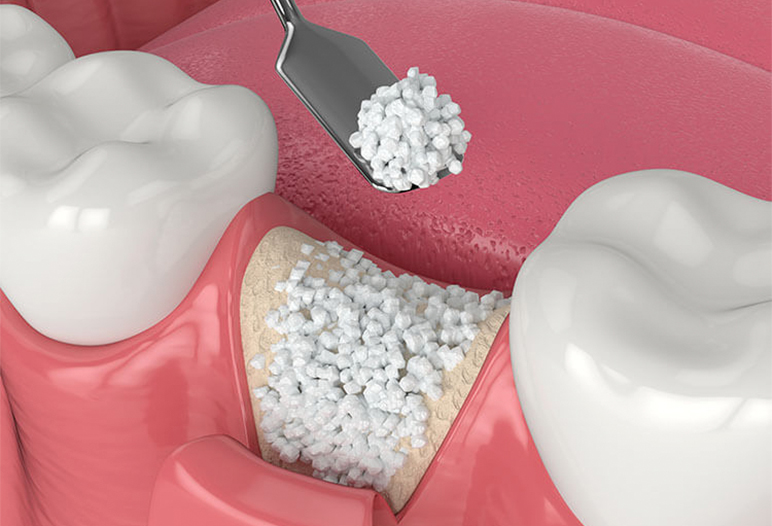
The cost varies depending on:
- The amount of grafting required
- The grafting material used
- The complexity of the procedure
One reason some patients investigate certain screwless systems is that specific implant designs may be suitable in situations where bone volume is limited.
However, suitability depends on individual anatomy and should always be determined by a qualified implant specialist.
Sinus Lift Surgery
In the upper back jaw, available bone height is sometimes reduced due to expansion of the maxillary sinus.
A sinus lift may be required to create sufficient bone support for implant placement.
This procedure can add significantly to overall treatment costs and treatment time.
Tooth Extraction
If a failing tooth remains in place, extraction may be necessary before implant treatment can begin.
Additional procedures such as infection management or socket preservation may also influence cost.
Temporary Teeth
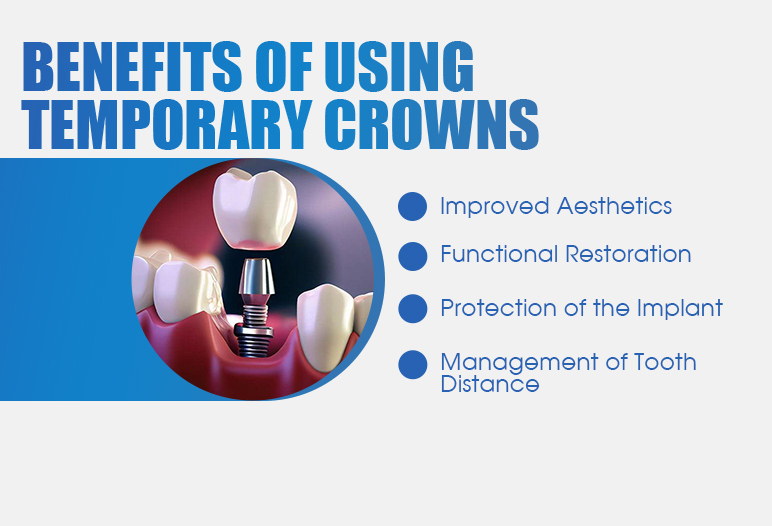
Temporary restorations are often overlooked when patients compare treatment quotes.
For highly visible areas, particularly front teeth, temporary teeth may play an important role during healing.
Periodontal Treatment
Healthy gum tissue is essential for long-term implant success. Patients with active periodontal disease may require treatment before implant placement can proceed safely.
Travel and Accommodation Costs
For international patients pursuing dental tourism, treatment expenses extend beyond the clinic.
Additional costs may include:
- Flights
- Accommodation
- Transportation
- Time away from work
These expenses should be included when comparing treatment options across countries.
Long-Term Risks and Maintenance Costs of Screwless Dental Implants
One of the most overlooked aspects of implant treatment is what happens after the restoration is completed.
The true cost of treatment is not limited to the day the implant is placed.
It includes the long-term maintenance required to keep the restoration healthy and functional for many years.
Understanding Total Cost of Ownership
A useful concept when evaluating implant treatment is total cost of ownership.
This refers to the combined cost of:
- Initial treatment
- Maintenance visits
- Future restorative work
- Management of complications if they occur
Looking at treatment through this lens often provides a more realistic understanding of value.
Potential Long-Term Maintenance Costs
Possible future expenses may include:
- Professional implant maintenance
- Occlusal adjustments
- Crown replacement
- Soft tissue treatment
- Management of biological complications
These possibilities exist with both screwless and conventional implant systems.
Peri-Implantitis
Peri-implantitis refers to inflammatory disease affecting the tissues surrounding an implant.
Risk factors include:
- Poor oral hygiene
- Smoking
- Uncontrolled systemic disease
- Irregular maintenance visits
Early diagnosis and intervention can help reduce treatment complexity and cost.
Bone Loss Around the Implant
Long-term bone stability depends on many factors, including:
- Surgical placement
- Occlusal loading
- Oral hygiene
- Patient-specific biological factors
Routine monitoring helps identify potential issues before they become significant problems.
Crown Wear or Damage
Even high-quality ceramic restorations can experience wear over time. Patients with heavy bite forces or bruxism may require periodic restorative maintenance.
Gum Recession
Changes in gum tissue may occur as patients age. In highly aesthetic areas, soft tissue changes can sometimes affect appearance and require additional treatment.
Can Screwless Implants Reduce Certain Maintenance Costs?
Potentially, yes.
Because screwless systems do not rely on a retaining screw, they may reduce the likelihood of maintenance related specifically to screw components.
However, patients should understand that implant success ultimately depends on:
- Oral hygiene
- Professional maintenance
- Treatment planning
- Long-term follow-up care
No implant system eliminates the need for ongoing care.
Final Thoughts: The Best Implant Is Not Always the Cheapest One
When patients first begin researching screwless dental implants cost, it’s natural to focus on the numbers.
After all, implant treatment represents a significant investment, and the difference between treatment quotes can sometimes be substantial.
However, after years of helping patients restore missing teeth, one thing becomes clear: the long-term success of an implant is rarely determined by the price alone.
A dental implant is not simply a titanium fixture placed into bone. It is a combination of diagnosis, treatment planning, surgical precision, restorative design, laboratory craftsmanship, and ongoing maintenance. Each step contributes to how the implant will function, look, and feel years from now.
This is why two treatment plans that appear similar on paper can produce very different long-term outcomes.
For some patients, a screwless implant system may offer meaningful advantages in aesthetics, restorative design, or maintenance. For others, a conventional implant system may provide an equally successful result at a lower initial cost. The right choice depends on your individual anatomy, treatment goals, expectations, and the experience of the team providing your care.
Rather than asking, “Which implant costs less?”, a more useful question may be: “Which treatment approach gives me the best chance of enjoying a healthy, functional, and natural-looking smile for the next 10, 20, or even 30 years?”
That perspective often leads to a much better decision.
Whether you are considering treatment in the United States, Australia, or exploring dental tourism in Vietnam, the goal should never be to find the lowest price. The goal is to find the right balance between quality, expertise, technology, long-term value, and peace of mind.
Because in the end, the true cost of an implant is not measured by what you pay on the day of treatment. It is measured by how well that investment serves you every day afterward.
FAQs
How long do screwless dental implants last?
A well-placed screwless dental implant can last for decades. In many cases, the implant itself may last a lifetime if the surrounding bone and gums remain healthy. Regular check-ups and good oral hygiene are often more important than the type of implant connection used.
Are screwless dental implants a good choice for front teeth?
Yes. Many dentists prefer screwless restorations for front teeth because there is no screw-access hole through the crown. This can make it easier to create a natural-looking tooth and achieve a more aesthetic result in the smile zone.
Can screwless dental implants be used for full-mouth restoration?
Yes. Screwless implant systems can be used to replace multiple teeth or even support a full-arch restoration. The best option depends on bone availability, bite conditions, and the overall treatment plan.
Do screwless dental implants need special maintenance?
No. They should be cared for much like natural teeth. Daily brushing, cleaning around the implant, and routine professional maintenance are usually all that is required to support long-term health and stability.
Can I get screwless dental implants if I have bone loss?
Possibly. Some patients with bone loss can still receive implant treatment, while others may need bone grafting or additional procedures first. A CBCT scan is usually the best way to determine whether enough bone is available.
Can a damaged screwless implant crown be replaced?
In most cases, yes. If the crown becomes chipped, worn, or damaged, it can often be repaired or replaced without removing the implant itself. The exact solution depends on the implant system and the condition of the restoration.
Am I too old for screwless dental implants?
Age alone is rarely a reason to avoid implant treatment. Many patients in their 60s, 70s, and beyond successfully receive dental implants. Overall health, bone quality, and healing ability are usually more important than age.
Can international patients complete treatment in one trip to Vietnam?
Some treatments can be completed during a single visit, while others require a healing period before the final crown is placed. The timeline depends on the number of implants, bone condition, and whether additional procedures are needed.
Are screwless dental implants more comfortable than traditional implants?
Most patients do not notice a difference in daily comfort once healing is complete. The main distinction lies in the implant connection design and restorative approach rather than how the implant feels during normal use.
What is the biggest advantage of screwless dental implants?
For many patients, the main advantage is the combination of aesthetics and engineering. Without a screw-access hole, the final crown can often be designed more naturally, particularly in highly visible areas such as the front teeth.
 Call
Call Booking
 Chat
Chat